PDK Poll of the Public’s Attitudes Toward the Public Schools
The 57th Annual PDK Poll
Improving Teacher Pay and Teacher Shortages are Priorities for Americans;
Elimination of U.S. Department of Education Not Strongly Supported
Report and visualizations by John G. Hendron, Ed.D. (email), Director of Public Relations, PDK International
Survey Design and Administration by The Wason Center for Civic Leadership at Christopher Newport University
Listen to John Hendron and Kathleen Vail discuss this year’s poll on an episode of There’s Power in Teaching.
Overview
A small loss in confidence in the public schools, alongside strong support for a slate of education priorities, are highlights gleaned from the 57th annual PDK Poll. Strong support for career and technical education programs, addressing teacher shortages, improving teacher pay, providing security to keep students and teachers safe, and inclusion initiatives lead as priorities for school leaders and policy makers.
Conducted annually since 1969, the PDK Poll on Public Attitudes Toward Public Education (formerly the Gallup/PDK Poll) delves into a range of education-related topics. These are a few highlights from this year’s poll:
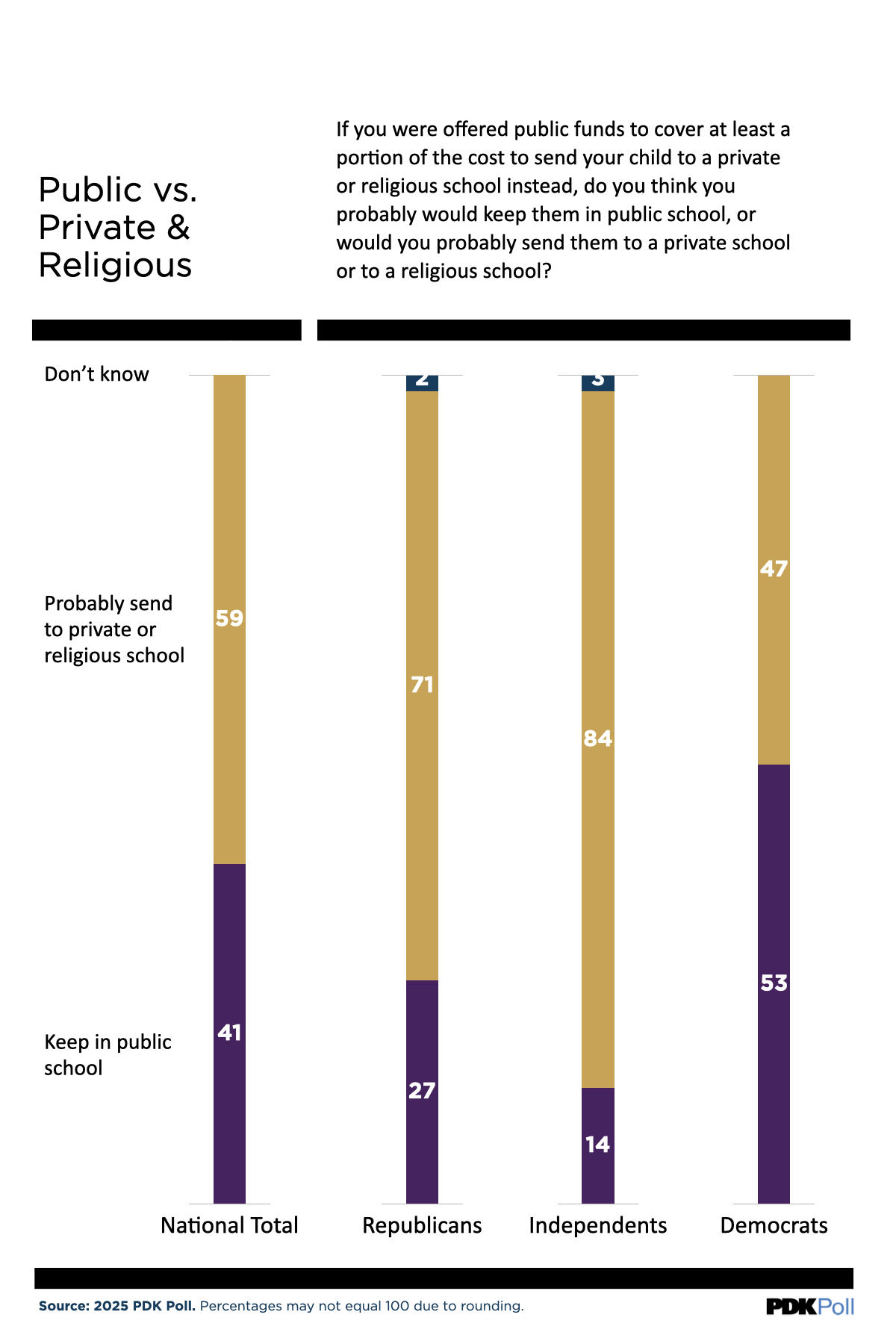
- Parents are interested in access to public education funding for the purposes of sending their children to private or religious schools. 59% of parents in the 2025 PDK Poll would send their child to a non-public school if at least partial funding was provided. This is up from 56% in support of using public funding to open families up to private options in 2020.
- The public interest in charter and lab schools remains steady from recent past polls, with 46% supporting funding these types of schools. Support for funding charter schools was 68% in the 2013 PDK Poll. Interestingly, support for charters across political ideologies was similar, but support from Black families was strongest.
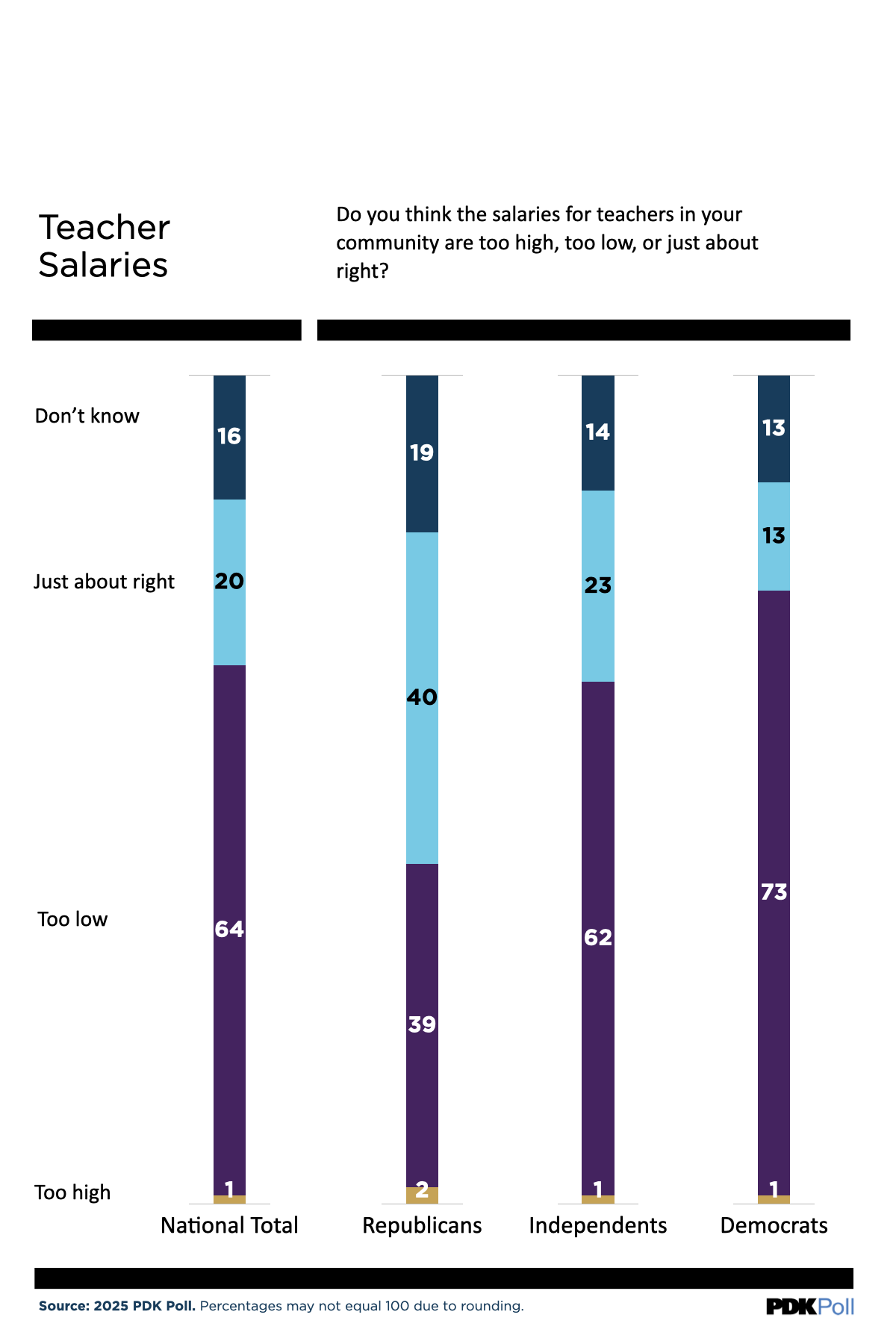
- Nearly two-thirds of Americans agree that teacher salaries are inadequate. 64% believe that teacher pay is too low—an urgent signal for states and districts facing teacher shortages and morale concerns. This belief was championed by Democrats (73% believing pay is too low) and less by Republicans (39% believing pay is too low).
- A majority of U.S. adults support limiting cell phone use during the school day. 46% percent prefer phones be allowed only during lunch and breaks, while 40% support a full-day ban. Only 11% favor unrestricted use—highlighting strong public support for setting boundaries on technology in the classroom.
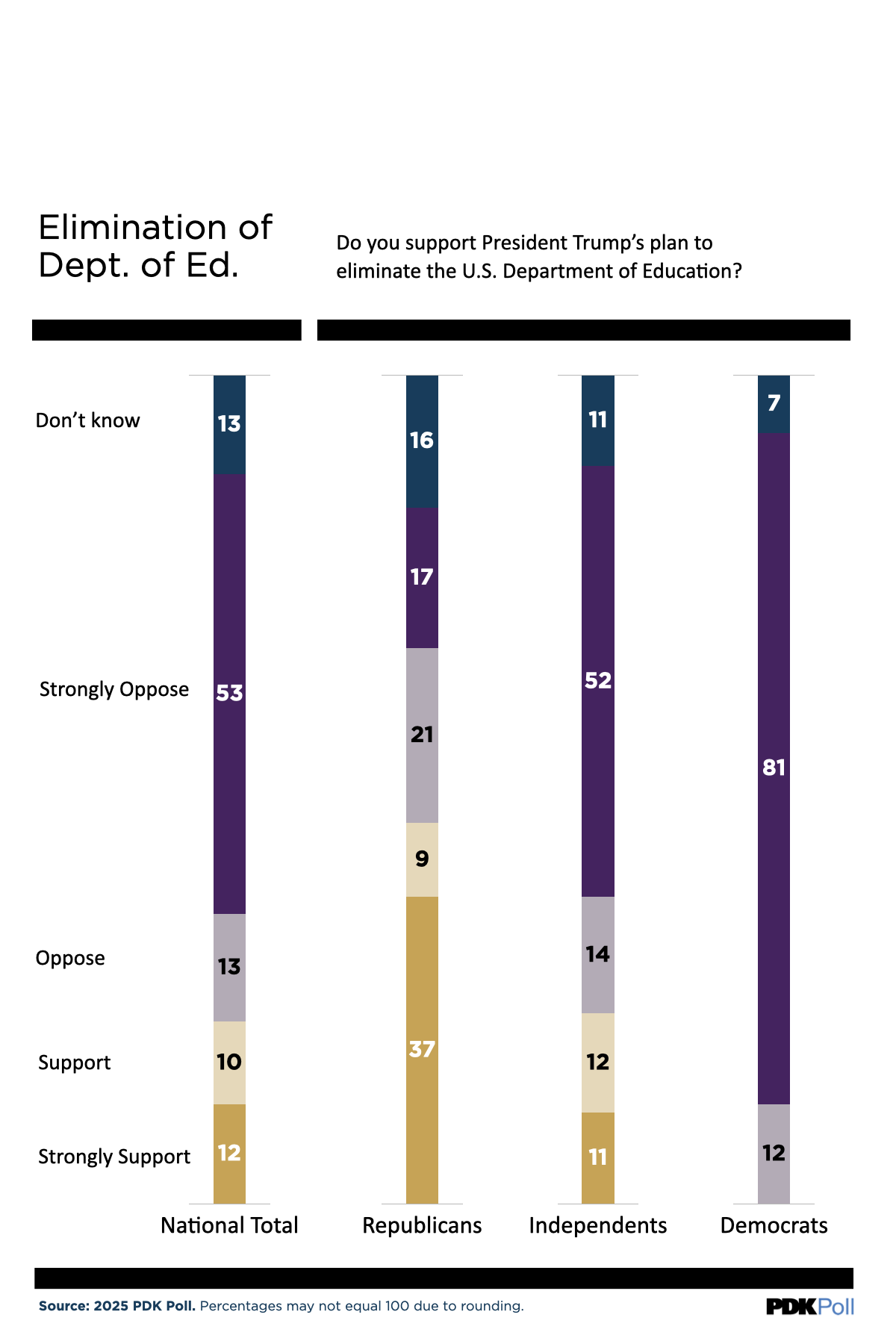
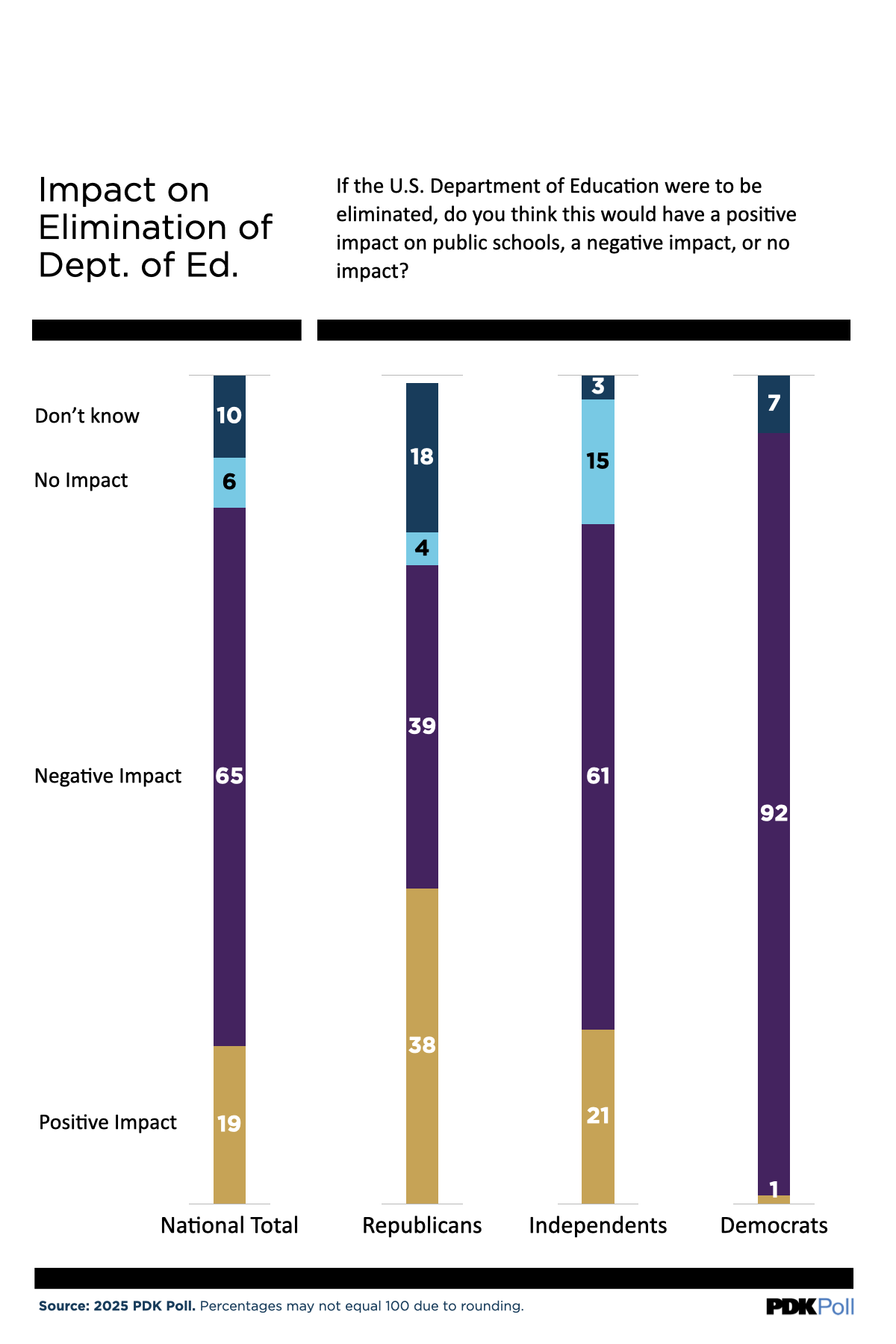
- Despite recent political proposals, 66% of U.S. adults oppose eliminating the federal education department. Most Americans (65%) believe the department’s elimination would have a negative impact on public education.
The survey was produced by The Wason Center for Civic Leadership at Christopher Newport University for PDK International, with data collected June 21-30, 2025, in English, among a representative, random national sample of 1,005 adults.
Analysis
Eroding Confidence in Public Schools?
Between our 1998 and 2005 polls, we asked the American public about their support for using public funds to provide access to private schools for children. Our results showed a range of support, between 33-44%. We asked the question again in 2007, including religious schools, where 50% of parents supported using public finding. In 2020, 56% of parents (and 53% of the general public) supported the use of public funds for private schools and 50% of parents supported the use of public funds for religious schools.
In this year’s poll, 59% of parents supported using public funding so that their child could attend a private or religious school. Among Republicans, 71% supported the use of public funding to send their child to a non-public school versus 47% of support from Democrats. Independents led in support of using public funding for non-public schools, at 84%.
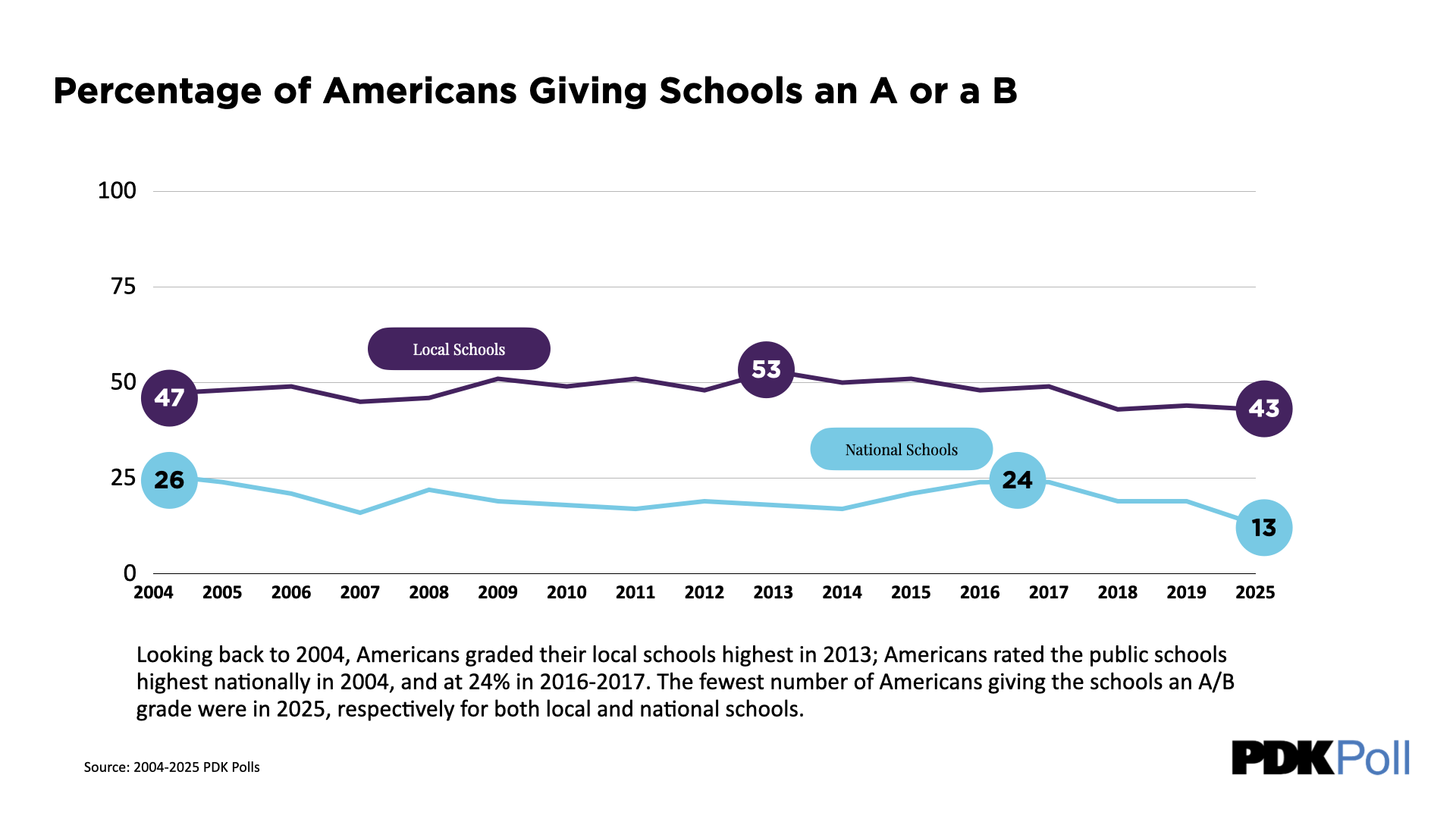
For over twenty years, we have asked respondents to grade their community’s schools and the nation’s public schools with a letter grade (A-D, Failing). Among the poll’s results from over twenty years of data, the 57th annual poll showed decreased support for the nation’s schools. 43% of respondents gave their own community’s schools a letter grade of A or B, down from 53% in 2013. Only 13% of respondents gave the nation’s public schools an A or B rating, down from 26% in 2004.
Support for charter schools and lab schools was not as high as in past PDK Polls. This year, 46% of respondents supported funding charters or lab schools, which typically receive public funding but may have different oversight. Support for charter or lab schools was highest among Democrats (51%), and nearly the same for independents and Republicans (44% and 45%, respectively). A 2023 Stanford University study highlighted increased performance of charter schools over public schools, after past reports of lackluster performance.
The public’s approval of charter schools was higher in previous PDK polls. In 2013, for example, support for charters was at 68%. One reason may be that other programs that give parents money to attend private or religious schools provide a different kind of alternative.
Eliminating the Department of Education
President Trump campaigned on eliminating the U.S. Department of Education, which among other things, is tasked with the dispersion of federal funds to states and districts, in addition to providing support for appeals of civil rights violations, of import to some families with students receiving special education services. The Trump administration has discussed giving more supervision of schools to state departments of education as part of the federal closure.
Only 12% of respondents strongly support the elimination of the U.S. Department of Education, with 66% opposing or strongly opposing closure. Interestingly, 34% of male respondents supported the agency’s elimination, versus 9% of female respondents. Attitudes different along political lines, with 46% of Republicans strongly supporting or supporting elimination of the department, versus 23% of independents, and 0% of Democrats.
Among our respondents, 19% believed eliminating the department would have a positive impact on public education, with 65% believing the opposite. 6% of respondents thought that eliminating the department would have no impact.
Teacher Salaries
School districts depend upon a combination of state, local, and federal funds to support their budgets. Personnel salaries are among the largest component of a school district’s budget. The National Education Association’s report on educator pay (2025) reports a national average starting salary for new teachers of $46,526 and an average national teacher salary of $72,030. They report that despite record-level increases in some states, that “teacher pay has failed to keep up with inflation over the past decade.” The effect on teacher salaries is that teachers are making “5% less than they did ten years ago.”
The 2018 PDK Poll revealed that 66% of the American public thought that teacher salaries were too low. In this year’s poll, that number shrunk to 64%, with 20% feeling that teacher salaries were “just about right” and only 1% believing that salaries are too high.
Using 2024 data, World Population Review reports the average teacher starting salary by state ranges between $58,409 (California) and $42,492 (Mississippi). The differences in pay between states has a relationship to different regional costs of living, but a 2018 report suggests there are other factors to explain the differences. For comparison, the World Population Review also publishes a livable wage chart by state, highlighting the minimum salary for a single adult with no children. The livable wage is defined as “the income required to cover basic family needs without reliance on outside assistance.”
It is important to note that our question asked respondents to consider teacher pay as it relates within their community, and that the regional breakdown of respondents was collected by region and not by state: 24% reported living in the West, 39% in the South, 17% in the Northeast, and 20% in the Midwest.
Across political ideologies, Democrats led in the belief that teacher salaries are too low (73%) versus 62% for independents and 39% for Republicans. 92% of our respondents believed addressing teacher pay is an important issue.

Cell Phone Policies and AI in the Schools
According to a May 2025 report, twenty-one states have instituted statewide policies or policy mandates around cell phone access in public schools. In this year’s poll, we wanted to see how the American public felt about access to cell phones in schools.
A complete ban on cellphone use throughout the school was supported by 40% of respondents; 46% supported access to cellphones outside of classroom activities such as during lunch or in-between classes. 11% of respondents do not support a cellphone ban, especially if use of the device helps students academically. Nevertheless, 86% of Americans support some kind of cellphone restriction for students during the school day.
In the 2024 PDK Poll, we asked all respondents about their support for the use of artificial intelligence in education. This year’s support for AI waned, most significantly for the purpose of assisting teachers in the creation of lesson plans.
Providing access to student data to AI software, including student grades, assessment data, or other personal information was not supported by 68% of parent respondents.
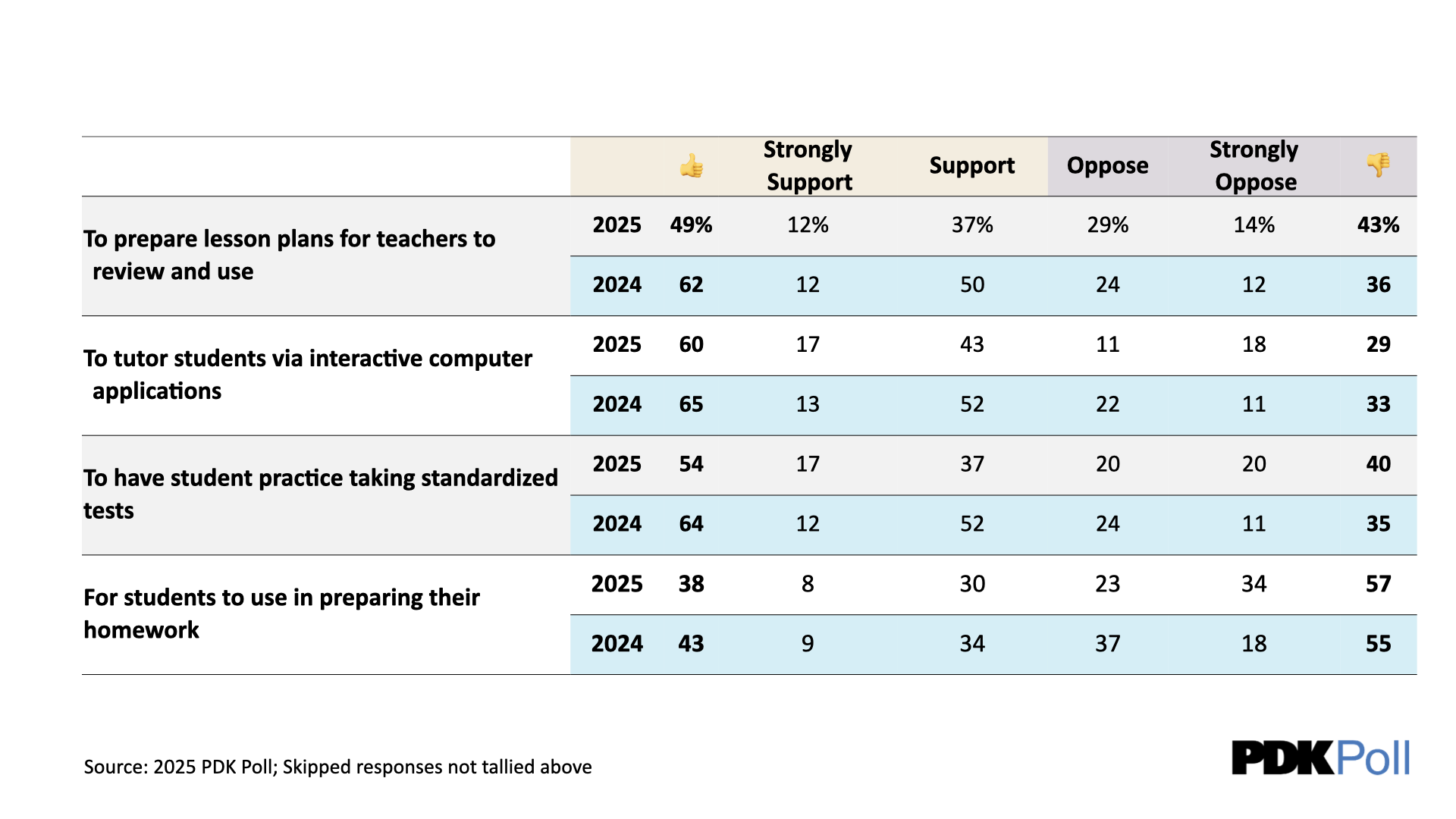
What uses of AI do you support in public education? Source: 2024-2025 PDK Polls. Skipped/not-answered responses are not tallied. Source: 2025 PDK Poll.

Do parents have a voice?
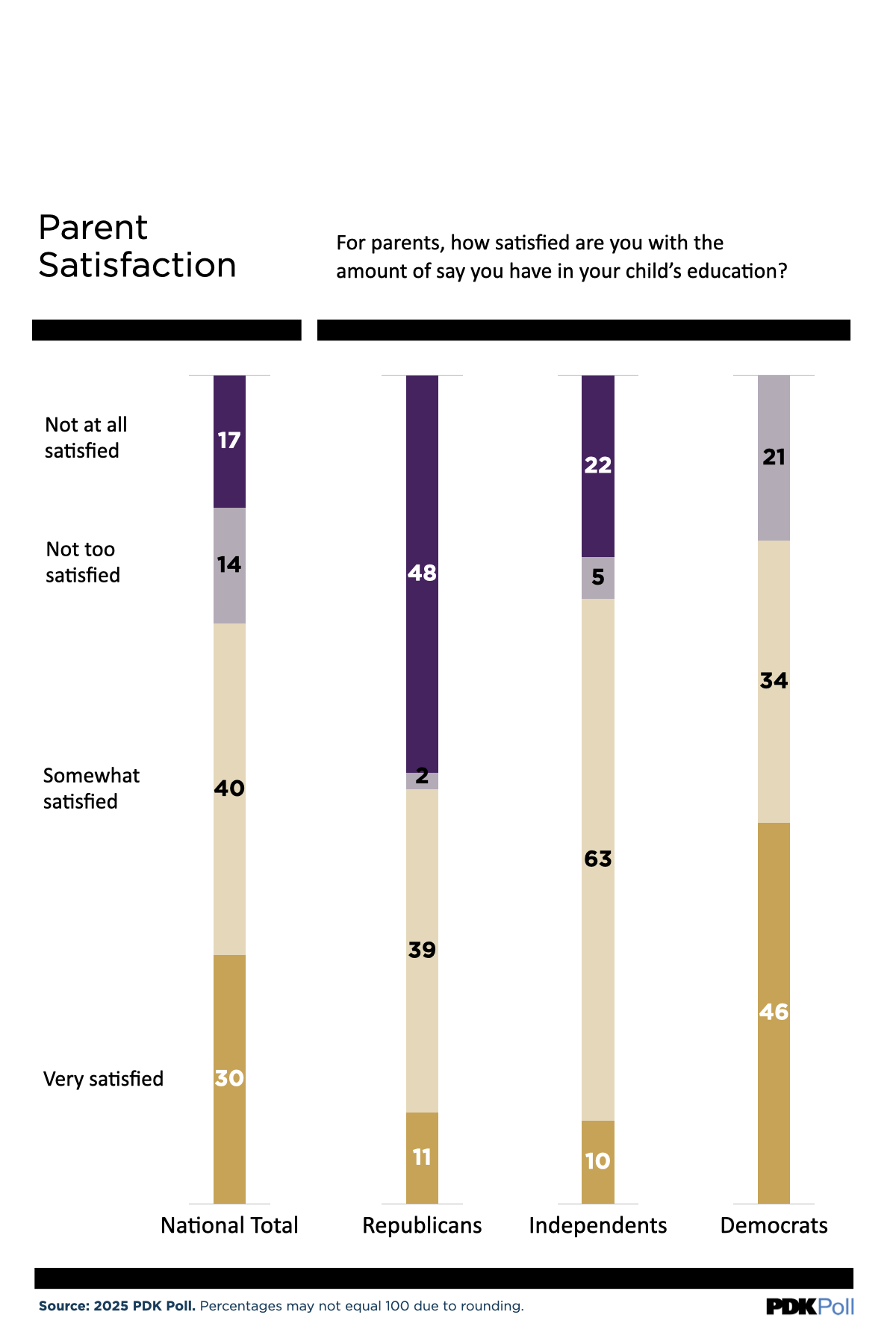
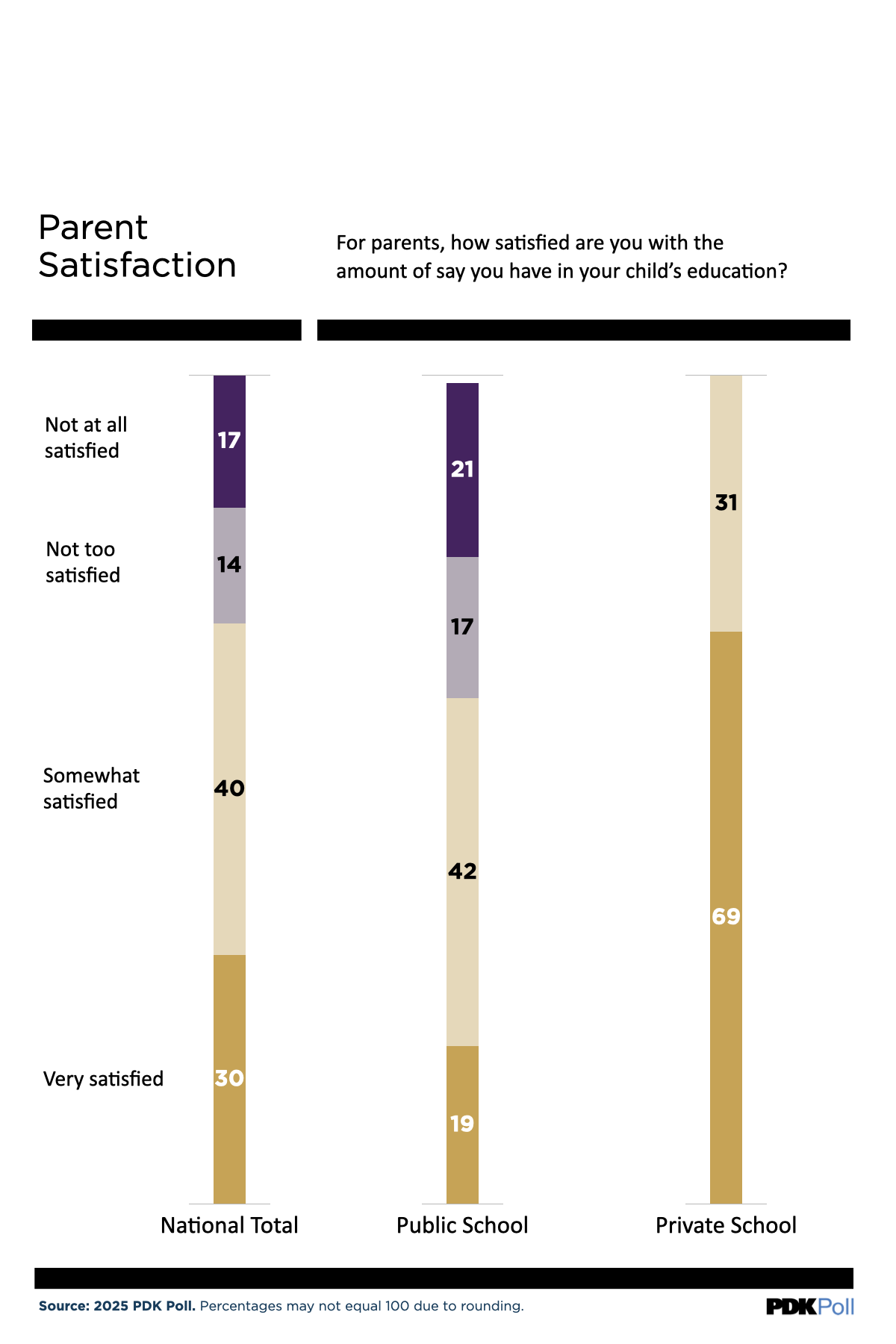
When we asked those who identified as parents if they are satisfied with the amount of say they have in their child’s education, 70% reported being satisfied (30% very satisfied and 40% somewhat satisfied). However, disparities in satisfaction emerge along political lines and whether or not their children attend a private or public school. 78% of parents represented in this year’s survey had children in public schools, versus 5% in private, and 1% reported their children being homeschooled.
What is important to the American public in 2025?
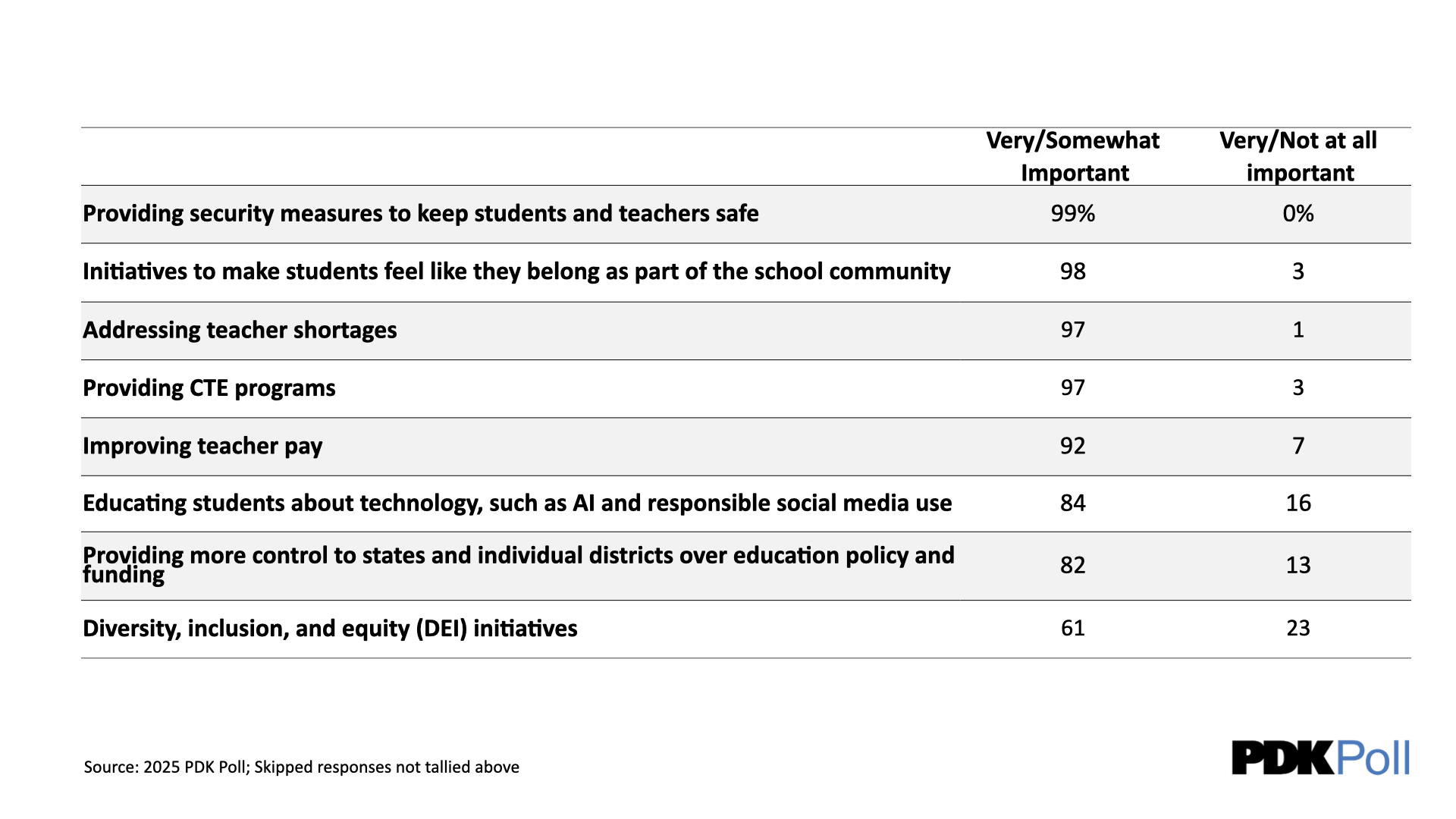
In this year’s poll, many of the potential education priorities listed garnered strong support. Among the highest priorities are initiatives to make students feel like they belong as part of the school community, career and technical education programs, addressing teacher shortages, and improving teacher pay. The most support was given to providing security measures to keep both students and teachers safe in America’s schools.

There was the least amount of consensus around support for DEI programming or initiatives: 61% of U.S. adults say diversity, inclusion, and equity initiatives are either very important (49%) or somewhat important (12%). 89% of Democrats said it is very/somewhat important compared to 22% of Republicans and 62% of independents.
Methodology and topline
The 2025 Phi Delta Kappa Poll was produced for PDK by The Wason Center for Civic Leadership at Christopher Newport University.
The survey was designed to consist of approximately 1,000 adults. Field work was conducted June 21-June 30, 2025 and the survey was conducted by telephone.
The results of this poll are based on 1005 interviews of US adults. The margin of error for the whole survey is +/-3.9% at the 95% level of confidence. This means that if 50% of respondents indicate a topline view on an issue, we can be 95% confident that the population’s view on that issue is somewhere between 46.1% and 53.8%. The margin of error for subgroups may be higher. All error margins have been adjusted to account for the survey’s design effect, which is 1.6 in this survey. The design effect is a factor representing the survey’s deviation from a simple random sample and takes into account decreases in precision due to sample design and weighting procedures. In addition to sampling error, the other potential sources of error include non-response, question wording, and interviewer error. Percentages may not equal 100 due to rounding. Five callbacks were employed in the fielding process. Live calling was conducted by Dynata interviewers. The data reported here are weighted using an iterative (raked) weighting process on region, age, sex, race, Hispanic, and education to reflect as closely as possible the US adult population. Parameters for the weights used in this survey come from the 2023 and 2024 US Census estimates.
Demographic Details
- 36% respondents completed high school or less; 64% completed college or advanced degrees.
- 18% identified as Latin/Hispanic; 76% reported as White, 15% as Black or African American; 8% as Asian and 1% as other.
- 50% of respondents identified as male; 50% responded as female.
- 17% of respondents live in the Northeast U.S.; 20% in the Midwest, 39% in the South, and 24% in the West.
- 12% of respondents were aged 18-24; 18% aged 25-34; 17% aged 35-44; 15% aged 45-54; and 38% as 55 or older.
- 18% of respondents identified as Republican; 31% as Democrats, 35% as independent, and 8% with no preference. The remainder did not know or did not answer.
- In terms of party leaning, 13% lean Republican, 12% lean Democrat; 18 % lean independent, and 8% did not know or did not respond.
- Finally, 12% of respondents reported a family income less than $25,000 per year; 18% reported family income at $25-49,999; 18% reported family income at $50-74,999; 15% reported family income at $75-99,999; 22% reported family include between $100-145,999; and 16% reported family income in excess of $150,000 per year.
PDF: Topline Survey Data
PDF: Survey Questions
References
CREDO (June 2023). As a matter of fact: The national charter school study III 2023. [Monograph]. Retrieved from: https://ncss3.stanford.edu/reports/report-downloads/
Federal Reserve Bank of St. Louis (1 November 2018). Why do teacher salaries differ so much across the country? [Blog post]. Retrieved from https://www.stlouisfed.org/on-the-economy/2018/november/why-teacher-salaries-differ-across-country
Geduld, A. (23 October 2024). Public funds, private schools: A new analysis of the early returns in eight states. The 74 Million. Retrieved from https://www.the74million.org/article/public-funds-private-schools-a-new-analysis-of-the-early-returns-in-eight-states/
National Education Association (29 April 2025). Educator pay data. Retrieved from https://www.nea.org/resource-library/educator-pay-and-student-spending-how-does-your-state-rank
Reinwald, A. (16 May 2025). Ballotpedia news. Four states enact cellphone bans in May so far. [Blog post]. Retrieved from https://news.ballotpedia.org/2025/05/16/four-states-enact-cellphone-bans-in-may-so-far/
World Population Review (2025). Living wage by state 2025. Retrieved from https://worldpopulationreview.com/state-rankings/livable-wage-by-state
World Population Review (2025). Teacher pay by state 2025. Retrieved from https://worldpopulationreview.com/state-rankings/teacher-pay-by-state
About the PDK Poll
The PDK Poll of the Public’s Attitudes Toward the Public Schools has been a steady reflection of U.S. opinion about public education since 1969. PDK produces the annual poll as part of its mission to engage educators and serve schools so every student thrives. The PDK Poll results provide researchers with some of the finest longitudinal data on how the public feels about the nation’s schools and education policies. Education policy makers use the poll’s findings to inform their decisions, and educators across the country use the results to guide planning and action in their communities. The 2025 PDK Poll was administered by The Wason Center for Civic Leadership.
Press inquiries:
Contact us at media@pdkintl.org or by phone at (571) 335-1787.