
PDK Poll of the Public’s Attitudes Toward the Public Schools
The 56th Annual PDK Poll
Federal focus on education initiatives wins broad public support
Overview
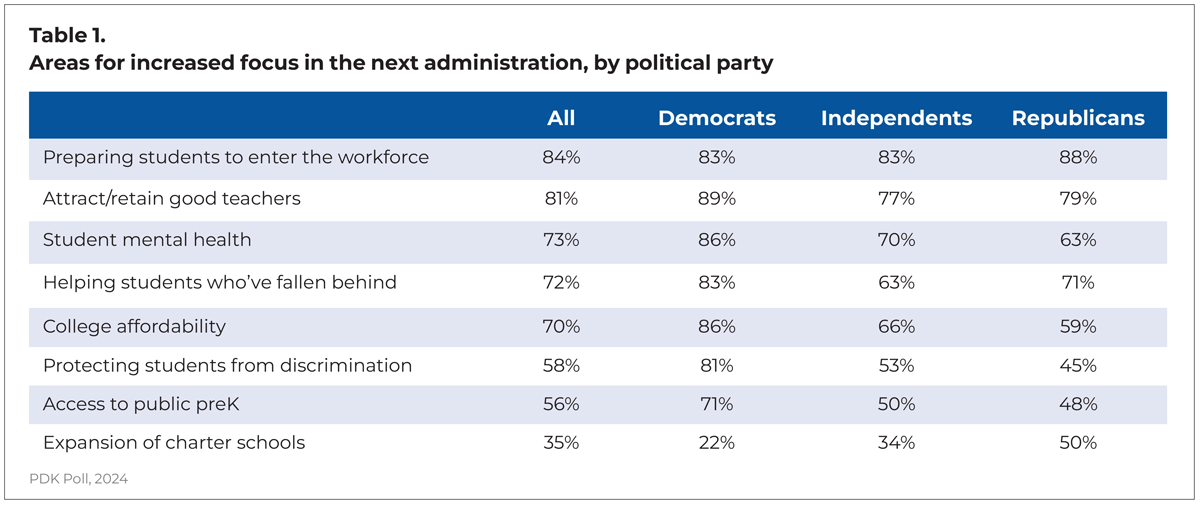
Preparing students to enter the workforce and attracting and retaining good teachers are Americans’ top educational priorities for the next administration in Washington, regardless of who wins the upcoming presidential election, the 2024 PDK Poll finds.
 While eight in ten or more Americans pick those two items as priorities, other policy priorities also win broad support. Seven in ten — or more — favor an increased focus on addressing student mental health, helping students who have fallen behind academically, and college affordability.
Two other priorities attract smaller majority support for increased federal attention: protecting students from discrimination (58%) and availability of public preK programs (56%, rising to 67% among public school parents). A last item lags: Just 35% call for an increased focus on expansion of charter schools.
Conducted annually since 1969, the PDK Poll on Public Attitudes Toward Public Education (formerly the Gallup/PDK Poll) delves into a range of education-related topics. These are a few highlights from this year’s poll:
- Support for an increased federal focus on the items named above is accompanied by support for greater funding for education in general. Sixty-one percent of Americans (rising to 71% of public school parents) prefer a candidate for political office who favors increased funding for the public schools. Among the rest, 29% would prefer a candidate who favors maintaining current funding; just 8% pick a candidate who would cut school funding.
- Sixty percent would not want a child of theirs to take up teaching in the public schools, much like the result to a similar question in the 2022 PDK Poll and sharply up from previous levels. When the question was first asked in 1969, 75% wanted their child to become a teacher, and it was as high as 67% as recently as 2011. Today just 40% say so.
- Among people who would not want their child to become a public school teacher, two reasons stand out: 33% cite inadequate pay and benefits and 27% cite a lack of discipline in the schools.
- Majorities support using artificial intelligence (AI) to help teachers prepare lesson plans, help tutor students via interactive computer applications, and allow students to practice standardized tests. Support declines to 43% for allowing students to use AI in preparing homework.
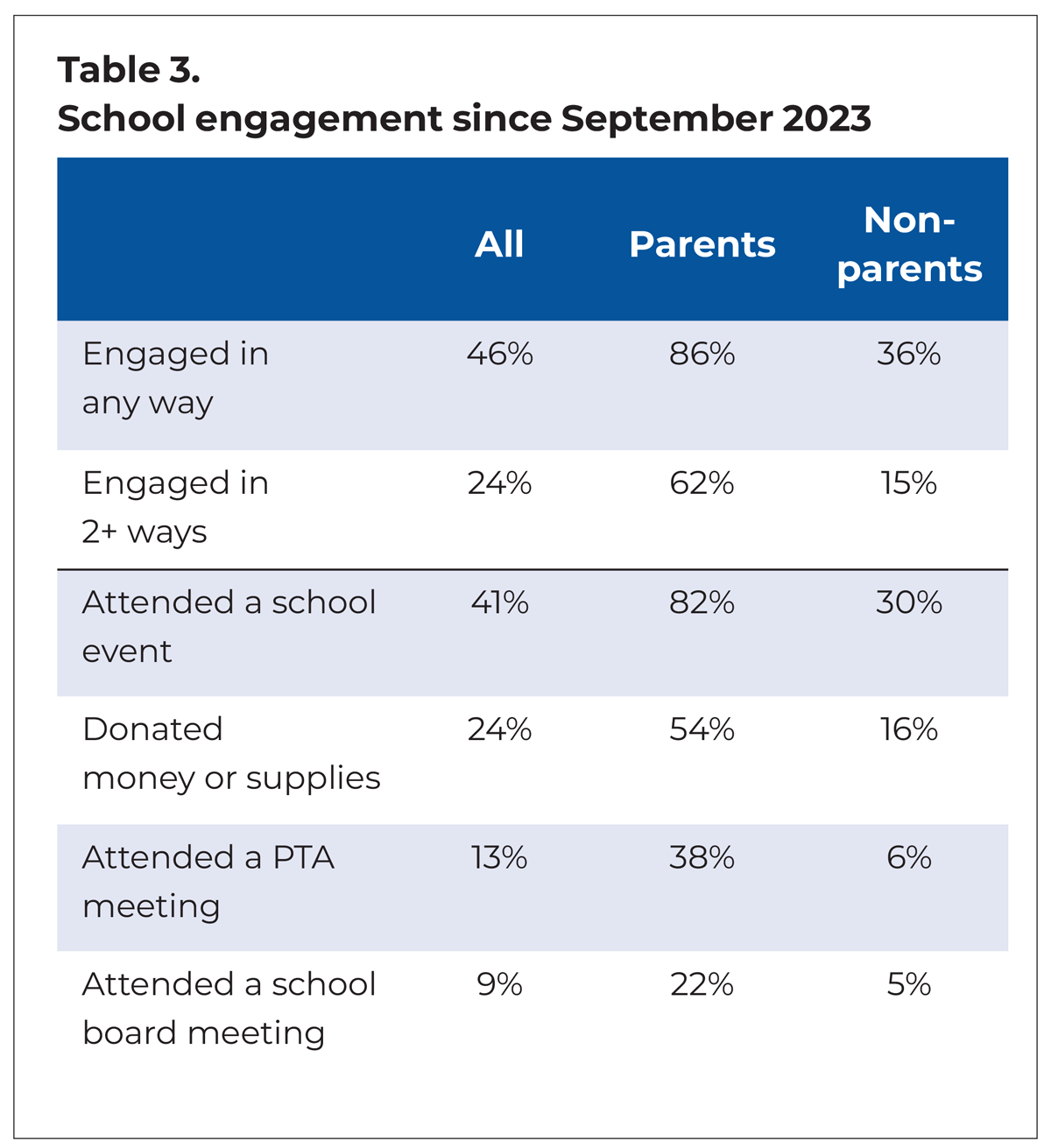
- Forty-six percent of Americans report engaging with their local schools in the past school year in at least one of four ways: attending a school event (41%); donating money or supplies (24%); attending a PTA meeting (13%); or attending a school board meeting (9%). Engagement overall and in each of those categories is considerably higher among public school parents than among non-parents.
- In political terms, 45% of Americans approve of how Joe Biden is handling education policy, while 50% disapprove. This closely approximates attitudes about Donald Trump’s performance on education policy in the 2020 PDK Poll, when 45% expressed approval and 53% expressed disapproval.
- Looking to the election in November, 54% say public education will be extremely or very important to their vote; 44% say it’ll be somewhat or not at all important. Among public school parents, more, 70%, say education will be important in their vote for president, including 31% saying it’ll be extremely important.
The survey was produced by Langer Research Associates for PDK International, with data collected June 21-July 1, 2024, in English and Spanish, among a representative, random national sample of 1,009 adults.
Priorities for the next administration
Most Americans support an increased focus from the next federal administration on seven of the eight education priorities tested in this survey (see list in Table 1). Apart from expanding charter schools, every priority receives majority support, including five with majorities of 70% or more.
Support for a much greater level of focus on these priorities is lower, but still substantial in several cases. For example, 47% support much more of a focus on preparing students to enter the workforce, and 36% to 41% express a desire for much more of a focus on attracting and retaining good teachers, college affordability, and addressing students’ mental health.
There are differences among groups, especially on the basis of political party and ideology. Democrats are 10 to 36 percentage points more likely than Republicans to favor an increased focus on six of the eight items tested. Republicans are 28 percentage points more apt than Democrats to support increased focus on a seventh, expanding charter schools. The gap shrinks to a slight 5-point difference on the top item, workforce preparedness. There are similar divides between liberals and conservatives.
Racial and ethnic differences also are apparent (Figure 1). Ninety percent of Black people say helping students who’ve fallen behind academically should be an area of increased focus, compared with 69% of white people; Hispanic people fall in between. There’s a similar pattern in responses related to student mental health and college affordability. In terms of increasing the availability of public preK classes, two-thirds of Black and Hispanic people alike favor an increased focus, compared with 50% of white people.
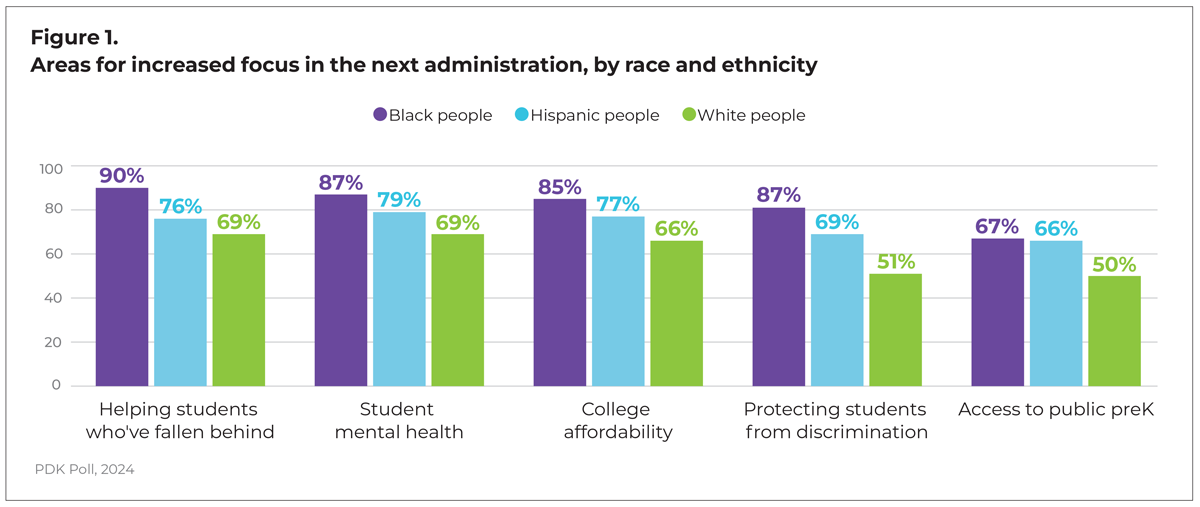
The largest difference is in protecting students from discrimination, with an increased focus supported by 81% of Black people, 69% of Hispanic people, and 51% of white people. Overall, the number of Americans favoring an increased focus on this issue has lost 10 percentage points from its March 2020 level (68% in 2020 vs. 58% in 2024). Other priorities tested in both 2020 and 2024 — college affordability, access to public preK, and attracting and retaining good teachers — showed smaller slips in support.
In other differences, women are 11 to 13 percentage points more likely than men to say the government should focus more on providing access to public preK, improving student mental health, and protecting students from discrimination. Women also are more apt than men, by single digits, to focus on helping students who’ve fallen behind academically and attracting and retaining good teachers. Rural Americans (59%) are less supportive of an increased focus on college affordability compared with urban (74%) and suburban residents (72%). And public school parents are 14 percentage points more likely than non-parents to support greater focus on access to public preK classes.
Overall though, these data reflect broad support across groups for various efforts to improve public education. There are few differences in these views by income, education, region, and parental status; and even among the groups with differences, majorities favor an increased focus on most items in the next administration.
Teaching as a career
Just four in 10 Americans would like a child of theirs to take up teaching in the public schools as a career. That is consistent with results from a similar question asked on the 2022 PDK Poll — and a far cry from the 75% of Americans who supported their child becoming a teacher when the question first was asked in 1969.
 This view is mostly consistent across the population, although with further partisan and ideological divisions. Democrats are 12 percentage points more likely than Republicans to want their child to become a teacher, and liberals — the only group reaching 50% support for a teaching career — are 20 points more likely than conservatives to say the same.
Among the six in 10 who wouldn’t want their child to teach in the public schools, most cite inadequate pay and benefits (33%) or a lack of student discipline (27%) as the primary reasons why. The rest split between saying the job of a teacher is thankless (17%); that they’re concerned about school safety (13%); or that the job is too demanding (9%). Inadequate pay also topped the list of concerns in PDK Polls in 2018 and 2022. (The response options differed in previous years, preventing direct comparison.)
Public school parents are especially concerned about pay and benefits, with nearly half saying it’s the main reason why they don’t want their children to teach. (The other half splits equally between the remaining items.) Pay and benefits is also the top issue cited by Democrats, liberals, and urban residents.
Student discipline, for its part, is the most important issue to Republicans, conservatives, and rural residents; non-parents split evenly between this concern and pay/benefits. Discipline was less frequently cited in open-ended and partially open-ended questions in 2018 and 2022.
Artificial intelligence in education
Majorities overall support three applications of AI technology in education (Table 2). More than 60% of Americans support the use of AI to prepare lesson plans for teachers’ review and use, to tutor students via interactive computer applications, and to have students practice taking standardized tests. Support falls to 43% for a fourth item, letting students use AI to prepare their homework.

While most people support three applications of AI tested in this survey, they did not indicate strong support, perhaps suggesting unfamiliarity with the technology. Using AI to help students practice standardized tests, for example, has just 12% strong support.
Public school parents’ views generally align with those of non-parents. On the top three items, the two groups are in sync; on the fourth, students using AI in preparing their homework, parents are slightly more supportive, 50% vs. 42%.
These questions continue the PDK Poll’s unique legacy of investigating attitudes about the role of emerging technology in education. Then under the direction of George Gallup, the poll first asked about technology in 1977 with a question about television limits for children at home. In the 47 years since then, it has investigated topics ranging from the introduction of internet-enabled computers to the classroom, early versions of online and asynchronous learning, and the advent of e-readers. Results from past PDK Polls, organized by topic, are available to PDK International members in their membership portal.
Engagement with local schools
Forty-six percent of Americans report engaging with their local schools in the past school year in at least one of four ways: attending a school event such as a concert, community night, or sports game (41%); donating money or supplies (24%); attending a PTA meeting (13%); or attending a school board meeting (9%).
Public school parents, 20% of the population, unsurprisingly play an outsize role in this engagement. A vast 86% of these parents engaged with their schools in some way in the past school year, including 82% who attended a school event, 54% who donated money or supplies, 38% who attended a PTA meeting, and 22% who attended a school board meeting. Sixty-two percent engaged in two or more ways. In contrast, just 36% of non-parents did any of the four things tested and only 15% engaged in two or more (Table 3).
 There are few differences among groups on the less popular items, attending a school board or PTA meeting. On others, women are somewhat more apt than men to have attended a school event (by 7 percentage points, 44% vs. 37%) and donated to their local schools (by 6 percentage points, 27% vs. 21%). People with household incomes of more than $100,000 per year are 10 percentage points more apt than those in the under-$50,000 category to have attended a school event, and 8 percentage points more apt to have made a donation. Sample sizes prevent disaggregation of results among public school parents.
It’s been 30 years since the PDK Poll last closely investigated the ways Americans engage with their community’s public schools. Of note, the last time similar questions were asked — in polls from 1983, 1991, and 1994 — patterns of engagement were akin to those today: attending school events was consistently more popular than attending school board or PTA meetings.
Politics and the presidential election
As mentioned above, 61% of Americans prefer a candidate for office who supports increased public school funding. This peaks at 82% among liberals; 79% among Democrats; and roughly seven in 10 among Black people, Hispanic people, and public school parents. It’s lowest among conservatives (40%); Republicans (47%); and rural residents (51%).
Public education is a significant election issue for many Americans, especially for public school parents. Fifty-four percent overall say the issue of public education will be extremely (25%) or very (29%) important in their vote for president; that rises to 70% among public school parents, including 31% who say it’s extremely important.
These results are nearly identical to those from the 2020 PDK Poll among parents, but the importance of education to the general public is down by 5 percentage points. Another similar result comes on approval ratings for handling education: In 2020, 45% approved of Donald Trump’s handling of education, with 53% disapproving; today, 45% approve of Joe Biden’s education policy and 50% disapprove. Partisan and ideological differences are vast.
At the time of data collection, Biden was still in the race for president and held a slight lead over Trump, 36% to 31%, in trust to handle education policy. The poll did not test the extent to which views about Biden’s handling of education policy will transfer to the Democratic nominee who replaced him, Vice President Kamala Harris.
Methodology and topline
The 2024 Phi Delta Kappa Poll was produced for PDK by Langer Research Associates via the nationally representative Ipsos KnowledgePanel®, in which participants are randomly recruited via address-based sampling to respond to survey questionnaires online. Households without internet connections are provided with a web-enabled device and service.
The survey was designed to consist of approximately 1,000 adults. Field work was conducted June 21-July 1, 2024. Out of 1,570 panel members invited to participate, completed surveys were provided by 1,018. The nine panelists who completed the survey in less than a quarter of the median completion time or who skipped more than three-quarters of the questions were deleted in quality control. The final sample included 1,009 U.S. adults.
Data were weighted via iterative proportional fitting to the following benchmark distributions of adults from the 2023 March Supplement of the Current Population Survey. Party ID benchmarks are from the 2023 National Public Opinion Reference Survey:
- Gender (male/female) by age (18–29, 30–44, 45–59, 60+)
- Race/ethnicity (white/non-Hispanic, Black/non-Hispanic, other or 2+ races/non-Hispanic, Hispanic)
- Education (high school or less, some college, bachelor’s and beyond)
- Census Region (Northeast, Midwest, South, West) by metropolitan status (metro, non-metro)
- Household income (less than $24,999, $25K to $49,999, $50K to $74,999, $75K to $99,999, $100K to $149,999, $150K or higher)
- Party identification (Republican, leans Republican, independent/other, Democrat, leans Democrat)
The survey has a design effect due to weighting of 1.12, for a margin of sampling error of plus or minus 3.3 percentage points for the full sample. Error margins are larger for subgroups, including plus or minus 7.4 percentage points for public school parents. Sampling error is not the only source of differences in polls.
PDF: Topline Survey Data
PDF: Survey Questions
About the PDK Poll
The PDK Poll of the Public’s Attitudes Toward the Public Schools has been a steady reflection of U.S. opinion about public education since 1969. PDK produces the annual poll as part of its mission to engage educators and serve schools so every student thrives. The PDK Poll results provide researchers with some of the finest longitudinal data on how the public feels about the nation’s schools and education policies. Education policy makers use the poll’s findings to inform their decisions, and educators across the country use the results to guide planning and action in their communities. Since 2016, Langer Research Associates has produced the poll for PDK.
Press inquiries:
Contact us at media@pdkintl.org or by phone at (571) 335-1787.

