
PDK Poll of the Public’s Attitudes Toward the Public Schools
The 54th Annual PDK Poll
Local Public School Ratings Rise, Even as the Teaching Profession Loses Ground
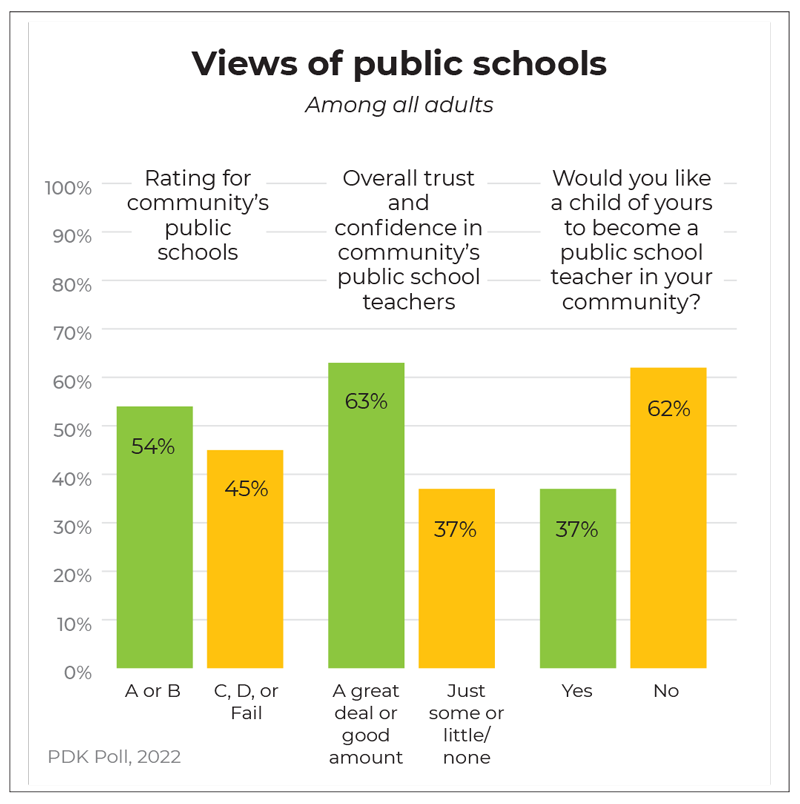 Americans’ ratings of their community’s public schools reached a new high dating back 48 years in this year’s PDK Poll of the Public’s Attitudes Toward the Public Schools, while fewer than ever expressed interest in having their child work as a public school teacher.
Results of the 54th annual PDK Poll tell a tale of conflicted views of public schools — local ratings are at nearly a five-decade high and a majority have trust and confidence in teachers, yet there’s wide recognition that the challenges they face make their jobs broadly undesirable.
Just 37% of respondents in the national, random-sample survey would want a child of theirs to become a public school teacher in their community. That’s fewer than have said so in a similar question asked 13 times in PDK polls since 1969. It compares with 46% in 2018, a high of 75% in 1969, and a long-term average of 60%.
The reasons for this reluctance are varied: Among the 62% who would not want their child to take up teaching, 29% cite poor pay and benefits; 26%, the difficulties, demands, and stress of the job; 23%, a lack of respect or being valued; and 21%, a variety of other shortcomings. Just among public school parents, slightly more, 38%, cite poor compensation.
This is the case even as 54% of all adults give an A or B grade to the public schools in their community, the highest percentage numerically in PDK polls since 1974, up 10 points since the question was last asked in 2019. The previous high was 53% in 2013; the long-term average, 44%.

The boost in confidence in public schools occurred among non-parents only; among K-12 public school parents, ratings of the local public schools are down 6 points from three years ago, although that’s not a statistically significant change given sample sizes. On another measure, public school parents are slightly less apt to give their own child’s school an A or B grade than in 2019, 68% vs. 75%.
As typically is the case, the nation’s schools as a whole are rated far less positively, with A’s and B’s from 23% of all adults and 30% of public school parents, both generally in line with previous results. While most people think their local schools are OK, their perception that schools elsewhere are subpar poisons the pot.
 Muted confidence in teachers
Overall, 63% of adults express trust and confidence in the public school teachers in their community, increasing to 72% of public school parents. That trust is somewhat muted, however: Just 16% overall say they have a great deal of trust and confidence in their community’s teachers; 47% express “a good amount” of trust.
On specific subject areas, moreover, trust in teachers subsides, ranging from 56% for the teaching of U.S. history in general to 38% for teaching issues related to gender and sexuality. Anywhere from 44% to 50% express trust in public school teachers on a range of other topics. These include how the history of racism affects America today, racial and ethnic diversity in society, media literacy, students’ social and emotional growth, and civics.
Trust in teachers on these topics generally is higher among public school parents than among all adults — by 11 points on history generally, the history of racism specifically, and social and emotional growth; 10 points on diversity; and a slight 7 to 8 points on the other items.
How different groups responded
There are differences among groups in ratings of their community’s public schools. These include a high of 64% A and B grades among adults with a postgraduate degree vs. 50% among those who haven’t gone beyond high school; 41% among Black people vs. 55% among all others; and 48% in urban areas vs. 58% in the suburbs. (It’s 55% in rural areas.)
Gaps are similar in those expressing general trust and confidence in their community’s public school teachers: 76% among postgraduates vs. 55% among those with no more than a high school diploma; 51% among Black adults vs. 65% among all others; and, politically, 73% among Democrats vs. about 6 in 10 independents and Republicans alike.
Respondents’ trust in teachers to handle specific topics flowed along ideological lines, with liberals expressing the most trust. Sixty-four percent of liberals trust teachers to teach U.S. history; that drops to 50% among conservatives. And 52% of liberals trust teachers on how the history of racism affects America today; just 39% of conservatives feel the same, with moderates in between. On teaching issues related to gender and sexuality, trust runs from 45% among liberals to 32% among conservatives. Conservatives and moderates alike are more skeptical than liberals of teachers on the topics of civics and students’ social and emotional growth.
Notably, just 33% of Black adults trust teachers on handling racial and ethnic diversity, compared with about half of others.
Broad support for security measures
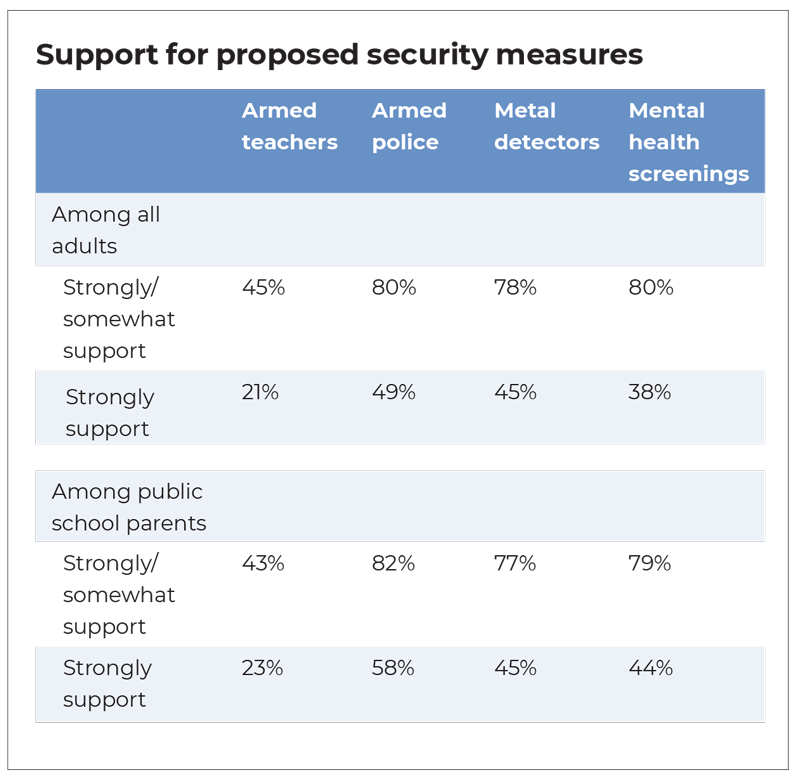
In the aftermath of the May 24 school shooting in Uvalde, Texas, Americans express broad, continued support for various security measures. Eighty percent support placing armed police officers on duty when classes are in session and screening all students for mental health problems; essentially as many, 78%, support placing metal detectors at all school entrances. It’s a different story on allowing teachers and staff to arm themselves: Support falls to 45%, with 55% opposed.
When examining how many of these respondents “strongly” support any of these measures, the drop in support is steep, suggesting that the public doesn’t see them as a panacea. Views among public school parents are similar to those among adults overall, with one difference in strength of sentiment: 58% of parents strongly support armed police officers in schools, compared with 49% of all adults.
These results are similar to the 2018 PDK Poll, which asked the same questions of public school parents after the mass shooting at Marjory Stoneman Douglas High School in Parkland, Florida. Likewise, results among all adults on allowing teachers to carry guns in school are virtually the same now as in a Pew Research Center survey in April 2021.
In addition to being the only measure to draw majority opposition, allowing teachers and staff to arm themselves also is the only item on which more Americans are strongly opposed, 34%, than strongly in favor, 21%. Strong opposition is in the single digits on all other suggested measures. A 2020 RAND Corporation study found that 28 states allowed schools to arm teachers or staff in at least some cases. One, Ohio, has moved to ease some school gun restrictions since the Uvalde attack.
Other aspects of the school security discussion are not covered in this survey but were asked in the 2018 PDK poll. In 2018, support among public school parents for allowing teachers and staff to carry guns in school rose to an even split if accompanied by 80 hours of training in the use of force, weapons proficiency, legal issues, and first aid, as well as approval by the school board and law enforcement authorities. At the same time, 68% of public school parents preferred to have their child in a classroom where the teacher did not carry a gun, and just 24% said having armed teachers or staff would make them feel that their child was safer. Additionally, that survey found a three-to-one preference for school spending on mental health services for students as opposed to armed guards.
 Sharp political divides
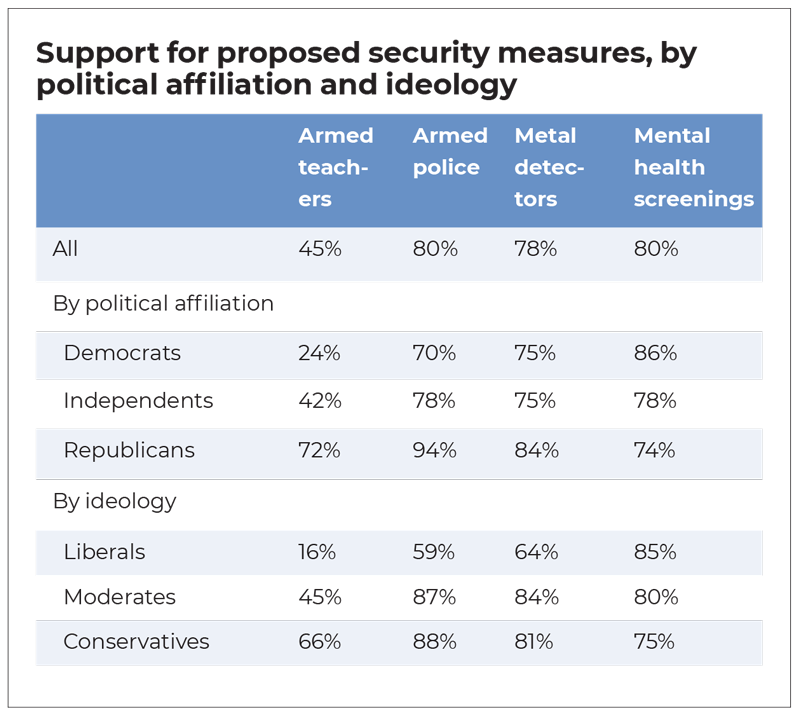
The sharpest divisions on school security issues are partisan, specifically on the question of allowing armed teachers and staff. Seventy-two percent of Republicans support this, dropping to 42% of independents and 24% of Democrats. The split by ideology is similar: 66% of conservatives are in support, compared with 45% of moderates and 16% of liberals.
Political gaps are narrower on two other items: armed police in the schools, which is backed by 94% of Republicans, 78% of independents, and 70% of Democrats; and metal detectors, favored by 84% of Republicans vs. 75% of Democrats and independents alike.
On the fourth item — mental health screening for all students — gaps run in the other direction, with higher support among Democrats (86%) and liberals (85%) than among Republicans (74%) and conservatives (75%), although there’s still substantial majority support in those groups.
There also are some differences by education and region. Armed teachers, armed police, and metal detectors receive markedly stronger support from less-educated Americans than among those who have college degrees, especially postgraduates. Those with no more than a high school diploma are 29 points more apt than postgraduates to strongly support metal detectors, 26 points more likely to strongly support armed police in schools, and 12 points more likely to strongly support allowing armed teachers and staff. There’s no meaningful gap between these groups on mental health screenings. Among other gaps, strong support for armed police in the schools is 13 points higher in the South than in the rest of the country. And overall support for allowing teachers to carry guns is particularly low in the Northeast, 35%, compared with 47% in the rest of the country.
References
Pew Research Center. (2021, April 20). Amid a series of mass shootings in the U.S., gun policy remains deeply divided. Author.
RAND. (2020, April 22). The effects of laws allowing armed staff in K-12 schools. In Gun Policy in America. Author.
Methodology and topline
These results are from a new nationally representative survey on issues in public education by Phi Delta Kappa International. The survey has been conducted annually since 1969, first as the PDK-Gallup Poll, and since 2016 as the PDK Poll, produced for the association by Langer Research Associates.
This year’s PDK Poll was conducted June 17-25, 2022, in English and Spanish, among a random national sample of 1,008 adults via the probability-based Ipsos KnowledgePanel®. Data were weighted via iterative proportional fitting to benchmarks for sex, age, race/ethnicity, region, education, and household income from the U.S. Census Bureau’s March 2021 Current Population Survey.
Results have a margin of sampling error of 3.3 points for the full sample, including design effects. Error margins are larger for subgroups, including 7.6 points for the sample of 179 public school parents.
PDF: Topline Survey Data
PDF: Survey Questions
A profession in crisis?
By Teresa Preston and Albert Chen
This year, as we developed our PDK Poll questions, protests at school board meetings were making headlines across the United States. Parents and activists were expressing their anger over COVID-19 policies, the availability of books they deemed inappropriate, the fear that critical race theory was infusing school curricula, and school policies and practices for addressing gender identities and sexualities. Of course, we know that the loudest voices are just that — the loudest voices. They do not necessarily represent the views of the wider community.
So, we wondered, how widespread is this anger and mistrust of public schools? This year’s PDK Poll attempts to look beyond the noise and find out what the public really thinks. And, by and large, the public gives high ratings to their local public schools and teachers. In fact, ratings for the public schools in their communities are at a five-decade high. And majorities of parents and nonparents alike trust the public school teachers in their communities overall.
The PDK Poll has historically found that the public rates their local public schools more highly than they do public schools in the nation as a whole, and that remains the case. In fact, it appears that, when it comes to public education, familiarity may breed support and trust. People give higher ratings to the schools they know than the schools they read about in the news. And parents, who see the fruits of teachers’ efforts in their children every day, express more trust in their local teachers than nonparents, who may be more distant from teachers’ daily activities. In fact, a majority of public school parents trust teachers to appropriately handle six of seven of the tricky topics we asked about in this year’s poll. (The exception is issues related to gender and sexuality.)
There are, however, reasons for concern. When it comes to trusting teachers to handle difficult topics, results are mixed. Although most parents trust teachers in these areas, the majorities are sometimes narrow, and trust generally was lower among nonparents, with majorities of adults overall expressing trust only when it comes to civics and U.S. history.
What the data do not reveal are the reasons for mistrust. We can make some guesses, given that the divisions often break down according to political party affiliation and ideology, with conservatives expressing less trust than liberal respondents. But it’s important to note that Black respondents are less trusting of teachers overall than white respondents and specifically in teachers’ ability to appropriately handle subjects related to racial and ethnic diversity in society. It’s important to remember that the reasons for mistrust may be different for each group.
Another potentially more alarming concern is the dwindling interest among parents in having their children become public school teachers in their community. In 2018, for the first time, a majority (54%) of adults said they would not want a child of theirs to become a public school teacher. This year, the percentage has risen to a record high of 62%. No single reason for this growing disinterest stands out — more than 20% alike cited poor pay, the demands and stress of the job and lack of respect.
The multifaceted nature of the problem requires multifaceted solutions. PDK International, through our Educators Rising program, seeks to spark interest in an education career among students. But current educators also need help to persevere in their work. One solution may be to lift up the voices of those who do respect and trust the teachers in their communities. Such community support can not only prevent demoralization but also lead policy makers to put in place concrete expressions of support, such as higher pay and improved working conditions. Most Americans do support public school educators — it’s time to make that known.
Teresa Preston is the director of publications and Albert Chen is the acting CEO of PDK International.
About the PDK Poll
The PDK Poll of the Public’s Attitudes Toward the Public Schools has been a steady reflection of U.S. opinion about public education since 1969. PDK produces the annual poll as part of its mission to engage educators and serve schools so every student thrives. The PDK Poll results provide researchers with some of the finest longitudinal data on how the public feels about the nation’s schools and education policies. Education policy makers use the poll’s findings to inform their decisions, and educators across the country use the results to guide planning and action in their communities. Since 2016, Langer Research Associates has produced the poll for PDK.

